Scientists are finding plastic where we never expected to look, in our oceans, our food, and in our human bodies. It’s time to understand the impact of plastic pollution and microplastics.
The microplastic evidence is growing
During that same window, researchers began finding plastic fragments inside human blood, lungs, arteries, and brain tissue. Two views of one curve.
Cumulative global plastic production · 1950 – 2026
Roughly 0 of the ~0 billion metric tons ever produced were made after 2000
Zoomed in: that same sliver, 2022 – 2026
What researchers found, in order
Microplastics are detected in human blood for the first time, opening the question of how far circulating particles travel through the body.
Follow-up studies locate particles across reproductive and respiratory tissue, broadening the map of where plastic accumulates.
A study in the New England Journal of Medicine finds that people with microplastics in coronary artery plaque face significantly higher cardiovascular risk.
Brain tissue shows more accumulation than any other organ tested — with roughly 50% more found in people who died in 2024 than in those who died eight years earlier.
Elevated nanoplastic concentrations appear in the brains of people with dementia versus those without. A causal link hasn't been established — the association is being actively studied.
Microplastics are identified in 90% of prostate cancer tumors sampled, and for the first time in gastric cancer tissue — at higher concentrations than in surrounding healthy tissue.
Metric tons of plastic produced globally every year, most of it single-use.
Of all plastic ever made ends up in landfills, oceans, and the food chain.
Disposable plastic bags used worldwide every year, nearly 1 million per minute.
How long a single plastic bag takes to decompose in a landfill.
Production figures are rounded estimates for a general audience, drawn from Geyer et al., Science Advances (2017), the OECD Global Plastics Outlook, and the European Environment Agency — not a precise annual series. Health findings are summarized from research compiled at Facts & Science, citing NEJM, Duke University, NYU Langone, and the Journal of Clinical Investigation.
During that same period, researchers began finding microplastics in human lungs, arteries, and brain tissue.
Metric tons of plastic produced globally every year, most of it is single-use.
Of all plastic ever made ends up in landfills, oceans, and the food chain.
Disposable plastic bags used worldwide every year, nearly 1 million per minute.
How long a single plastic bag takes to decompose in a landfill.
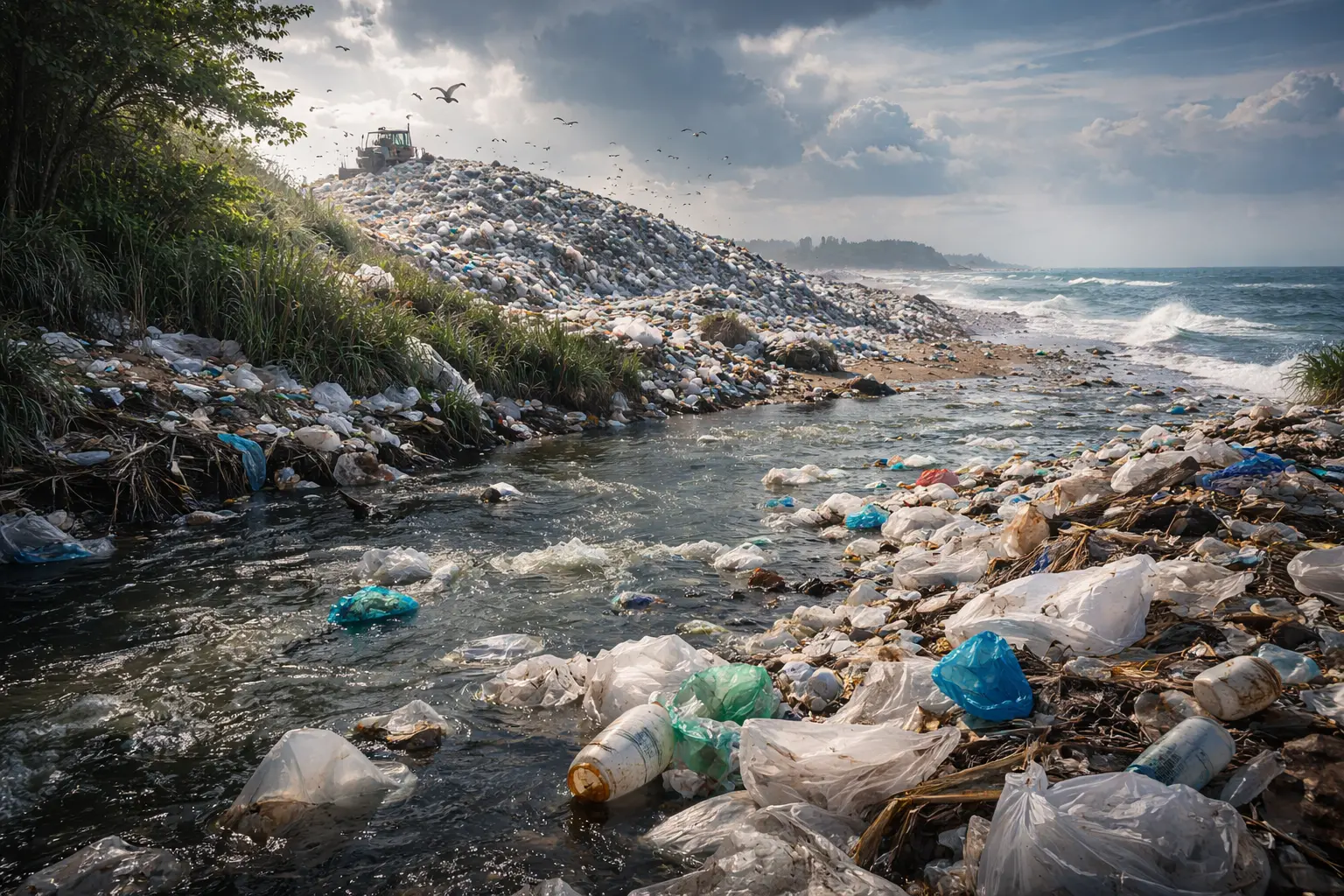
But plastic pollution rarely disappears. It moves…
And eventually, into places we never expected.
ONE PROBLEM. TWO CONSEQUENCES.
We can’t see microplastics… But that doesn’t mean they aren’t changing our world.
8 million metric tons of plastic enter our oceans every year.
That's 253 kg every single second.
You don’t have to eliminate plastic from your life overnight.
Every reusable bottle. Every refill. Every bag you use twice. Every better choice adds up.
Millions of small actions can create meaningful change for our families, our health, and our planet.